What Is the Super Guarantee?
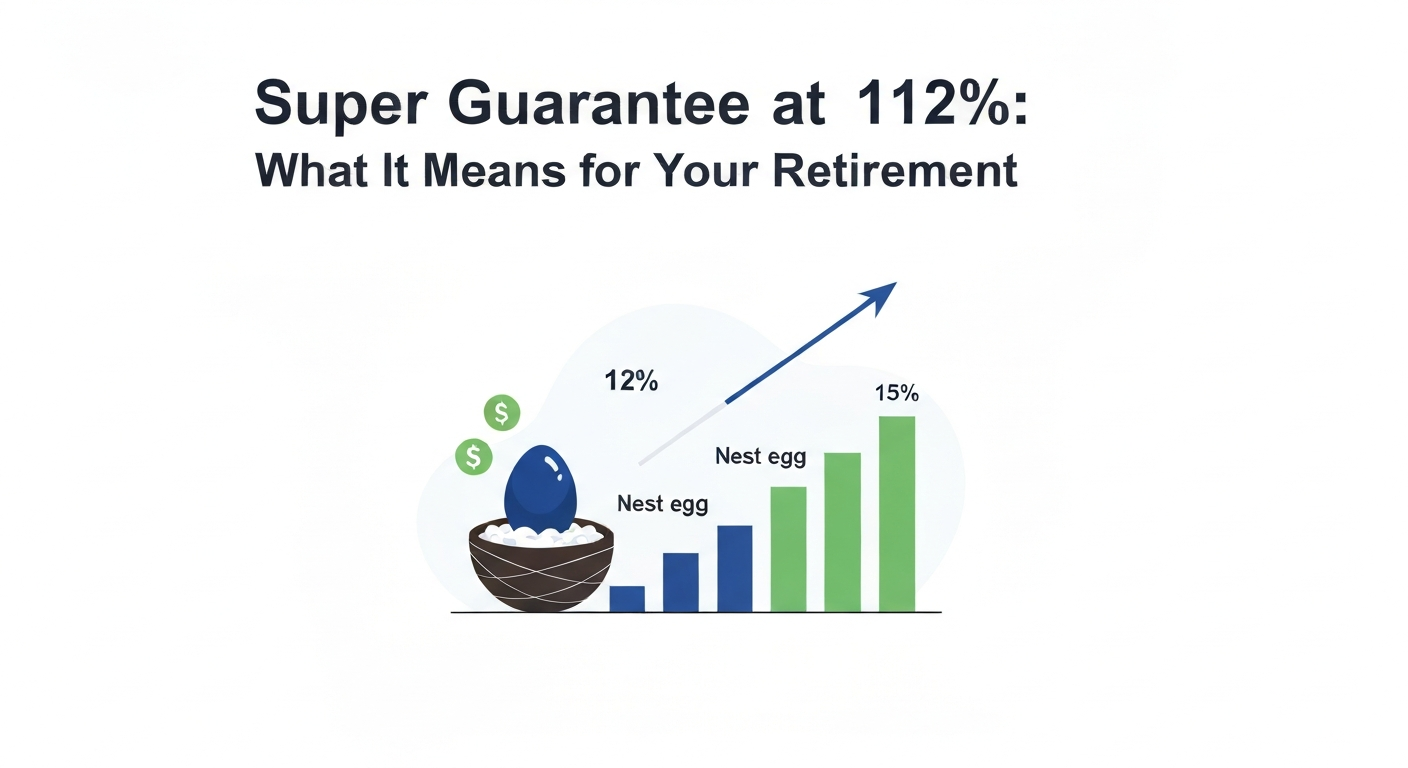
The Superannuation Guarantee (SG) is the minimum percentage of your ordinary time earnings that your employer must contribute to your superannuation fund. It's one of the most important retirement policy settings in Australia — and it has been gradually climbing for years.
The journey: 9.5% for many years, rising to 10% in 2021–22, 10.5% in 2022–23, 11% in 2023–24, 11.5% in 2024–25, and finally 12% from 1 July 2025. That's the legislated ceiling — no further increases are scheduled.
Calculate your Super Guarantee entitlement →
What Changes at 12%?
For most employees, the change from 11.5% to 12% is automatic — your employer simply adjusts the contribution rate from the new financial year. If your salary is $80,000, here's the annual difference:
- At 11.5% (2024–25): $9,200 super per year
- At 12% (2025–26): $9,600 super per year
- Additional super per year: $400
That $400 might not sound transformative. But invested inside a super fund for 20–30 years, the compounding effect is substantial. More on that below.
Does Super Come Out of My Salary or Is It Extra?
For most Australian employees, the SG is paid in addition to your salary — it doesn't reduce your take-home pay. Your employment contract should clearly state whether your package is "base salary + super" or "total package including super." If it's the latter, a higher SG rate effectively reduces your take-home pay as more of the fixed package goes to super. Always clarify this before accepting an offer. Model different scenarios with our Take Home Pay Calculator →
The Power of Compound Growth Inside Super
Super's real magic comes from time and compounding. Because returns are reinvested and the fund keeps growing, even small increases to your contribution rate can make a large difference to your retirement balance.
Consider two scenarios for a 30-year-old earning $75,000, assuming 7% annual return and 35 years to retirement:
- At 11.5% SG: ~$8,625/year in super → projected balance of approximately $1.24 million
- At 12% SG: ~$9,000/year in super → projected balance of approximately $1.30 million
That's an extra $60,000 in retirement from what seemed like a small rate change. Model your own super balance growth →
Who Is Eligible for the Super Guarantee?
Virtually all employees are entitled to the SG, regardless of:
- Whether they work full-time, part-time, or casually
- Whether they're a permanent resident or on a temporary visa (with some exceptions)
- How many hours per week they work (the old $450/month threshold was removed in 2022)
The SG applies to your ordinary time earnings, which includes your base salary, allowances, and commissions, but generally excludes overtime.
Making Voluntary Contributions to Supercharge Your Super
The SG is the floor, not the ceiling. You can contribute more voluntarily:
- Concessional contributions (salary sacrifice or personal deductible) — taxed at 15% inside the fund. The annual cap is $30,000 for 2024–25 (including employer contributions).
- Non-concessional contributions — made from after-tax money. Annual cap is $110,000, or up to $330,000 using the three-year bring-forward rule.
If you're serious about building wealth, learning the rules around super contributions is one of the highest-leverage things you can do. Calculate the impact of additional super contributions →
For a deep dive, check out Australian superannuation guide books on Amazon — there are some excellent titles that cover contribution strategies, pension phase planning, and the tax rules in detail.
Action Steps for 2025
- Confirm with your employer that the 12% rate will apply from 1 July 2025
- Check that your super is going to the correct fund (use the ATO's online tool via myGov)
- Review whether salary sacrificing additional super makes sense given your income and tax rate
- If you have multiple super accounts, consider consolidating to avoid paying multiple sets of fees