Why Your Power Bill Keeps Growing
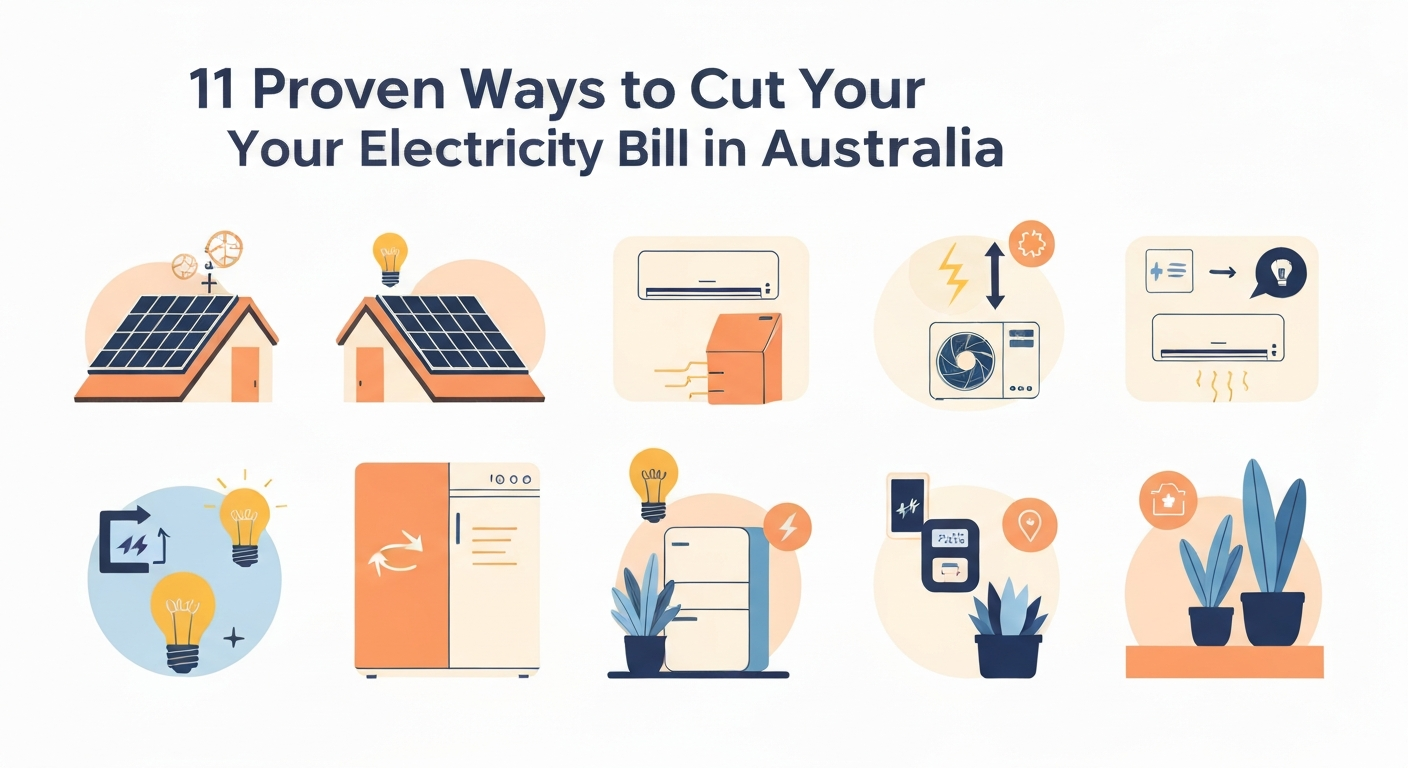
Australia has some of the most expensive residential electricity in the world — wholesale prices have been volatile, network costs have risen, and most households haven't changed their habits or plans to match. The average Australian household now spends $1,400–$2,200 per year on electricity, with higher bills in QLD and SA.
The good news: there are legitimate, proven ways to reduce that number significantly. Use our Electricity Usage Calculator to benchmark your current spend before working through this list.
1. Compare and Switch Retailer (Free, 15 Minutes)
This is the highest-impact, lowest-effort action most Australians can take. Energy retailers compete aggressively for customers — but only reward switchers, not loyal long-term customers. Use the government's Energy Made Easy comparison tool (for NSW, ACT, SA, QLD, TAS) or Victorian Energy Compare to see every available offer side by side.
Savings of $200–$500 per year from switching are common. Set a calendar reminder to compare again every 12–18 months.
2. Call Your Current Retailer First
Before switching, call your existing retailer and tell them you're considering leaving. Retention teams often have access to better rates than published offers. A five-minute phone call has resulted in $150–$300 annual savings for many households.
3. Time Your Heavy Appliances
If you're on a time-of-use tariff (common with smart meters), the difference between peak and off-peak rates can be 15–25 cents per kWh. Running your dishwasher, washing machine, and dryer after 10pm or before 7am can meaningfully reduce your bill. Check your bill or retailer's website to confirm your tariff type.
4. Fix Your Hot Water System
Water heating accounts for roughly 25% of the average Australian home's energy use. If you have an electric storage hot water system running on a continuous tariff, switching to off-peak tariff hot water (it heats overnight when power is cheapest) can save $200–$400 per year with zero hardware changes — just a call to your retailer.
5. Get a Smart Power Strip
Standby power (devices left on but not in active use) can account for 5–10% of your electricity bill. Smart power strips cut power to devices when they enter standby. Check out energy-saving smart power strips on Amazon AU — they pay for themselves quickly.
6. Seal Draughts and Improve Insulation
Heating and cooling is often the biggest ticket item on Australian power bills — up to 40% of energy use in southern states. Draught-proofing doors and windows (cheap DIY job using foam tape or door snakes) can reduce heating and cooling needs by 10–20%. Ceiling insulation, if your home lacks it, is one of the highest-return home improvements available.
7. Set Your Air Conditioner Thermostat Smarter
Every degree of cooling below 24°C adds approximately 10% to your cooling costs. In winter, every degree of heating above 18°C adds a similar penalty. Setting your split system to 24–26°C in summer and 18–20°C in winter — and using a timer to pre-cool/heat before you arrive home — cuts usage without sacrificing comfort.
8. Switch to LED Lighting Throughout
If you still have any halogen or incandescent globes, replace them with LEDs. LEDs use 75–80% less electricity and last 15–25 times longer. The payback period is under 12 months in most cases. Browse LED globes on Amazon AU for bulk packs that make the switch easy.
9. Install a Smart Meter and Monitor Your Usage
Smart meters give you visibility into exactly when and how you're using electricity — by the hour, if needed. Most Australian distributors now offer smart meter upgrades for free. Combine with your retailer's app or a third-party energy monitor to identify your biggest drains.
10. Consider Solar Panels
If you own your home and your quarterly bill is over $200, rooftop solar is likely your best long-term investment for energy savings. Average payback periods in Australia are now 4–8 years, with 25 years of panel warranty remaining. Use our Solar Savings Calculator to model your system and payback period, and compare against your current spend with the Energy Bill Calculator.
11. Apply for Government Concessions
Every state government has energy concession programs for eligible households — pensioners, Health Care Card holders, and low-income families. Contact your state's energy regulator or use Service NSW / Service Victoria to check your eligibility. These concessions can be worth $200–$500 per year and are completely separate from your retail plan.
Your Action Plan
Start with the free wins: compare retailers, call your current one, check your tariff type, and look for standby drains. These alone can save $300–$600 per year. Then layer in the efficiency investments — insulation, LED lighting, solar — over the following 12–24 months. Track your progress using our Electricity Usage Calculator to measure the real impact of each change.